God chose wisely in selecting a metaphor for the relation and tie between Christ and His church. What is something that every human being will be able to relate to? Many metaphors would not be understandable over centuries of cultural, social, economic and technological change. If He had compared it to an oxen pulling a plow, the parallel would be vague and insignificant for today’s generations of city dwellers. If He had compared it to an automobile and its owner, centuries of Bible readers would have been mystified until the early twentieth century, when the car was finally invented.
A Universal Metaphor
But here is something that every human being from the beginning of time until now can understand: the body. We all have one. We all have a body and we all have a head. If you were missing either of those, you sure wouldn’t be reading this article! We might not understand all the intricacies of how our bodies function, but we at least understand what it’s like to have one. And God has set it up so that with this basic, universal knowledge, we can have a direct insight into the relation between us as the church and Christ as our Savior and Lord.
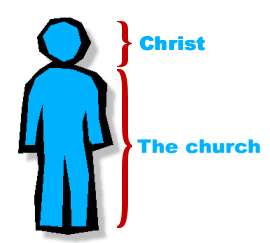
There are two instances in the Bible that most directly state this relation:
“And He put all things in subjection under [Jesus’] feet, and gave Him as head over all things to the church, which is His body, the fulness of Him who fills all in all.” Ephesians 1:22-23
“[Jesus] is also head of the body, the church…” Colossians 1:18
So it’s as simple as that. Now let’s check out some applications.
The Marriage Application
One of the most noticeable applications springing from this relationship is the teaching of the apostle Paul in Ephesians 5:22-23:
“Wives, be subject to your own husbands, as to the Lord. For the husband is the head of the wife, as Christ also is the head of the church, He Himself being the Savior of the body.”
The principle is that the body is in submission to the head. This principle can be seen in such areas as:
- Politics, where the body of citizens is subject to the laws and leadership of its parliament, congress, monarch, president, or other such individual or group that would make up the governmental “head” of the nation.
- Sports, where the body of players on the team is under the guidance of the coach as its “head,” and the they are in submission to the coach’s decisions and calls.
- Business, where every major corporation has an individual or group of executives as the “head,” who is over the whole “body” of employees in the company.
In Ephesians 5, Paul teaches that in a symbolic, spiritual, but very real-life and practical way, the husband is “the head” of the wife. It is a matter of male spiritual leadership. He is the head of the home, and he is the head of his wife, as Christ is the head of the church.
The parallel here in Ephesians 5 develops into these applications:
- Wives are encouraged to be subject to their husbands as the church is to Christ. (5:22-24,33)
- Husbands are challenged to truly love their wives, not just in any old way, but in the way that Christ loves the church, as demonstrated by the amazing acts of love and sacrifice He made on her behalf. (5:25-27)
- Husbands are taught to love their wives as they would their own physical body, since the wife is the spiritual, symbolic body of the husband. Among other things, this involves nourishing and cherishing her. (5:28-30,33)
Throughout all of this practical, down-to-earth teaching on the marriage relationship, Paul is referencing the relation between Christ and the church, as he notes at the end in verse 32:
“This mystery is great; but I am speaking with reference to Christ and the church.”
Some Implications in the Religious World
Church Organization
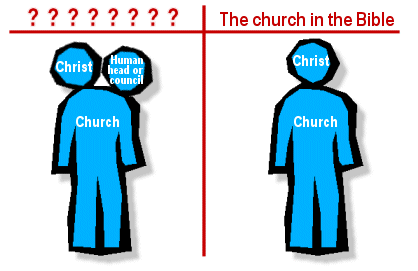
Do you know of any churches that have a headquarters on earth? A President, pope, or governing assembly to make decisions of doctrine or any other matter for the church or denomination as a whole? Keep that in mind, and now compare it to the picture the Bible paints:
Denominational Division
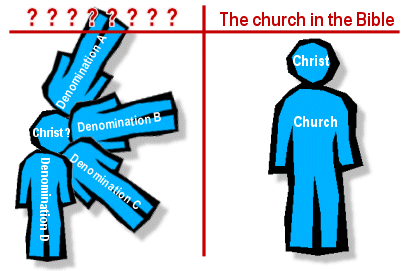
Although it is outside the scope of this article to delve into the religious meanings and definitions of what a denomination is, most any religious observer can see that there are many of them within the Christian world. Indeed, even for those who reject the practice of embracing denominational identities and organizations, it can nevertheless be hard to avoid denominational behaviors and mindsets. While we aren’t here trying to take a detailed look at the implications of denominational division, for the purposes of this article, we will take a brief look. Consider the following comparison:
Some Implications Within the Body
Christ and the body
The above are just two organizational implications of the church-body relationship as we have seen in the New Testament, and examples of how things have gone awry in other “churches.” But there are also things to consider in applying this metaphor to the true body of Christ, His church.
- Going it alone – Sometimes an individual Christian, for one reason or another, will grow negative toward the church, and decide he or she does not need to associate with them. “I don’t need the church,” he might say, or, “The church isn’t that important. I just need Jesus.” Hello? Can you reject the body but keep the head? We must keep in mind that Christ considered His church so important that He gave up His life for her; who are we to say otherwise?
- Who calls the shots – As we already saw, the body is in submission to the head. Consider your own physical body. It is through the head that the body receives air to breathe, food and water to survive, vision to guide its steps, and hearing to sense its surroundings. It is from the head (the brain) that the body’s movements are masterfully controlled. Now consider Christ and the church. Who controls the church? Who guides the church? For the church to be its own source of guidance, vision, direction and life is like a body trying to control itself apart from the brain. The church must follow its head, rely on its head. This involves being dedicated in faithful submission and abiding in the guidance and direction of Christ (John 8:31-32). There are too many churches out there trying to be the church, but they are not the body that is connected to the head. They are lost, like a decapitated chicken whose body keeps running. They might think they are getting somewhere, but without the true head as their source, they will fall over dead sooner or later. We, as the church, must stand firm in who we are, and whose we are. We belong to the head, Christ.
- The headless horseman – Along these lines, what happens if the head is separated from the body? It’s dead. It’s no mistake that decapitation is a time-tested manner of putting a body to death. You don’t have to lay a finger on the body; all you must do is separate its connection to the head, and the body is instantly useless and dead. So it is with the church of Christ. Without the head — Christ — the church is just any other group of people. It is the head that gives it not only identity, but also life (eternal, especially), purpose, direction and hope. Christ has promised that nobody can cut us off from Him against our will (Romans 8:35-39). But He leaves His body with the free will, the choice, of whether to remain in Him or not. In other words, nobody and nothing can sever the body of Christ from the head except the body itself, by its own choosing. The religious term for this is apostasy — to leave Christ, His teaching, His “headship.”
Members of the one body
Regarding those within the one body, there is much Biblical discussion on our relationship with one another as members, or individual parts, that make up the whole body. This, too, is a subject that can be discussed more thoroughly on its own.
In short, we can summarily say that it is crucial for the body to cooperate with itself, for the parts to function in harmony and health. Practically speaking, this involves avoiding bickering, quarreling, and selfish treatment of each other. It also involves keeping each other in line in a loving and caring way, and keeping each other spiritually balanced and strong. It is fitting for us to close this discussion with a quote from the New Testament that captures the essence of this idea:
“But speaking the truth in love, we are to grow up in all aspects into Him who is the head, Christ, from whom the whole body, being fitted and held together by what every joint supplies, according to the proper working of each individual part, causes the growth of the body for the building up of itself in love.” Ephesians 4:15-16